
WHY FABLE PICKED THIS
Claude Fable 5.1 · Founder-supplied thesis
The price: The supplied thesis estimated a 45–48% chance of a Giants win at an entry around 40.4¢. The potential edge depended on that estimate being right.
The matchup: Fable’s case was that New York could use Dart’s mobility and a run-and-possession approach to shorten the game and limit Dallas’s offense.
The limit: Pass at 45¢ or higher. Dallas’s offense, coaching changes, and turnover risk could break the case. The founder reports this thesis was generated before kickoff; this summary was added after settlement.
Source: a Claude Fable 5.1 thesis supplied by PickRecon’s founder, who reports it was generated before kickoff. This case study summarizes that document and was published after settlement on September 14, 2026. The original model-chat timestamp has not been independently verified.
The call was about probability versus price.
The thesis put New York’s chance of winning at 45–48%, against an entry cost of approximately 40.4¢ per contract. Its argument was a disagreement with the market’s assessment of the matchup. It did not claim a special fill below prevailing prices.
That distinction matters: a team can be more likely to lose than win and still offer value at a sufficiently low price. Here, any claimed edge depended on the model’s estimate being better than the market’s. The supplied document does not establish that the estimate was calibrated or validated.
The football thesis: shorten the game.
Fable’s case centered on New York’s new coaching staff, Dart’s mobility, and a possible run-and-possession approach. The thesis identified Greg Roman’s experience as a senior offensive assistant as one reason to consider that approach. The proposed path to an upset was to sustain drives, reduce Dallas’s offensive possessions, and pressure Dak Prescott when Dallas had the ball.
It also argued that Dallas’s defensive transition could create an opening early in the season. These are the supplied model’s matchup judgments, not evidence that a scheme advantage had been measured or guaranteed.
Contemporaneous Giants reporting supplied some relevant context: the game was at MetLife, and Dart’s previous start against Dallas produced 230 passing yards, two touchdowns, no interceptions, and 32 rushing yards. That report also described Dallas’s new defensive coordinator Christian Parker and roster additions, reasons to avoid simply projecting the old defense forward.
Giants pregame player report, September 11, 2026. This supports matchup context, not the thesis’s numerical win estimate.
The price limit was part of the pick.
The supplied thesis called for passing at 45¢ or higher. Around 40.4¢, its estimated probability left room for a potential advantage; a higher entry price would consume that margin. Fees and the actual available fill still matter.
For illustration, a 46% win estimate at 40.4¢ implies roughly 14% expected return on the amount spent before additional costs. That is conditional arithmetic, not a realized return or proof of a 14% edge. If the probability estimate is wrong, the conclusion changes with it.
What could have broken the thesis?
The document acknowledged Dallas’s offensive strength, uncertainty around New York’s new staff, and the risk of penalties, turnovers, or a game that forced the Giants to abandon their preferred pace. It also raised concerns about New York’s personnel and player availability. A run-and-clock case becomes much weaker if the opponent builds a large early lead.
The recorded result.
The founder’s receipt marks the Giants position “Won,” with $492.38 purchased and $1,217.94 credited. Treating that credit as total settlement value gives an effective entry cost of approximately 40.43¢ and a payout-minus-purchase difference of $725.56. The $1,217.94 is not net profit. The screenshot alone does not establish fees, funding treatment, or the account’s overall return.
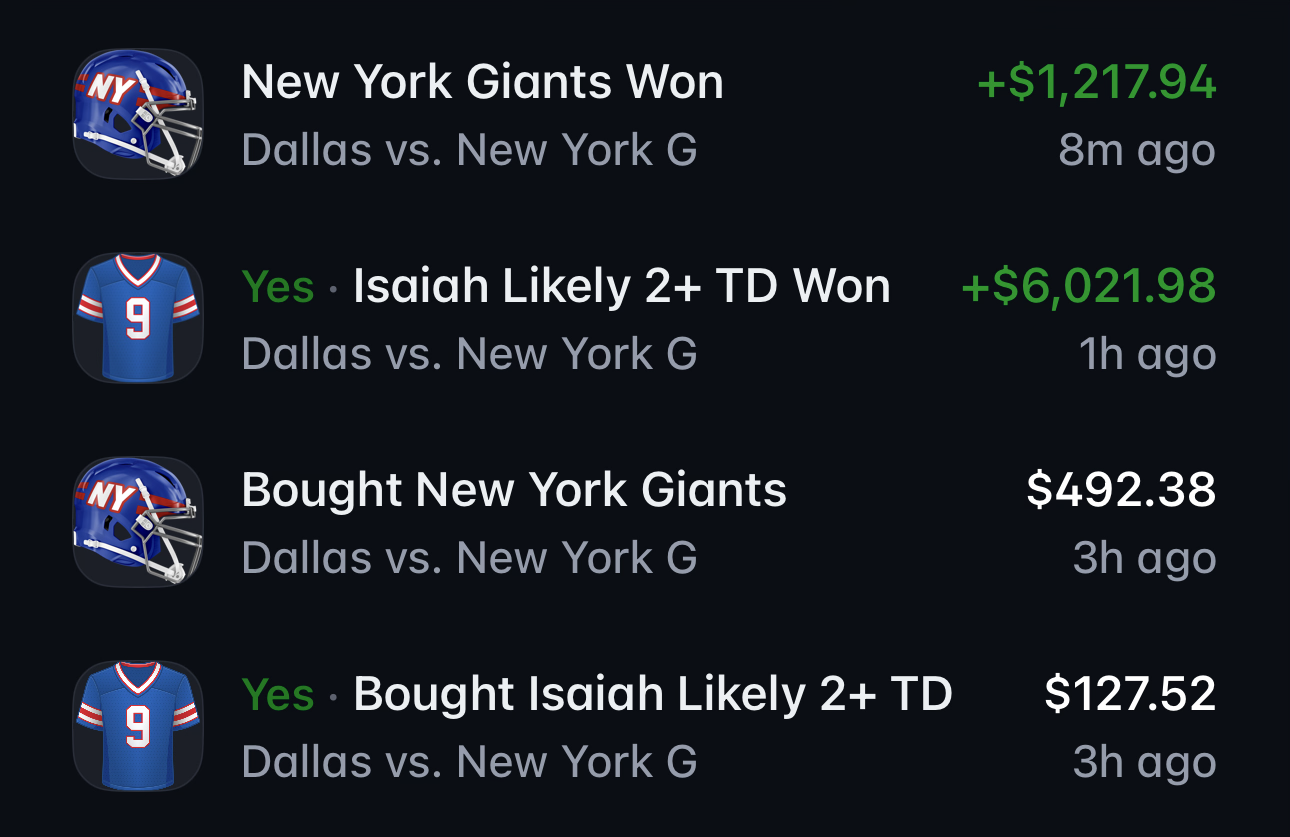
One result, with the reasoning attached.
The Giants moneyline and Likely 2+ touchdowns were separate positions in the same game. They share game risk and are not independent demonstrations of predictive skill. The Giants win records the outcome; it does not validate the 45–48% estimate. Closing prices and a broader record of similar calls would help evaluate the process.
Read the Isaiah Likely case · View the complete launch record